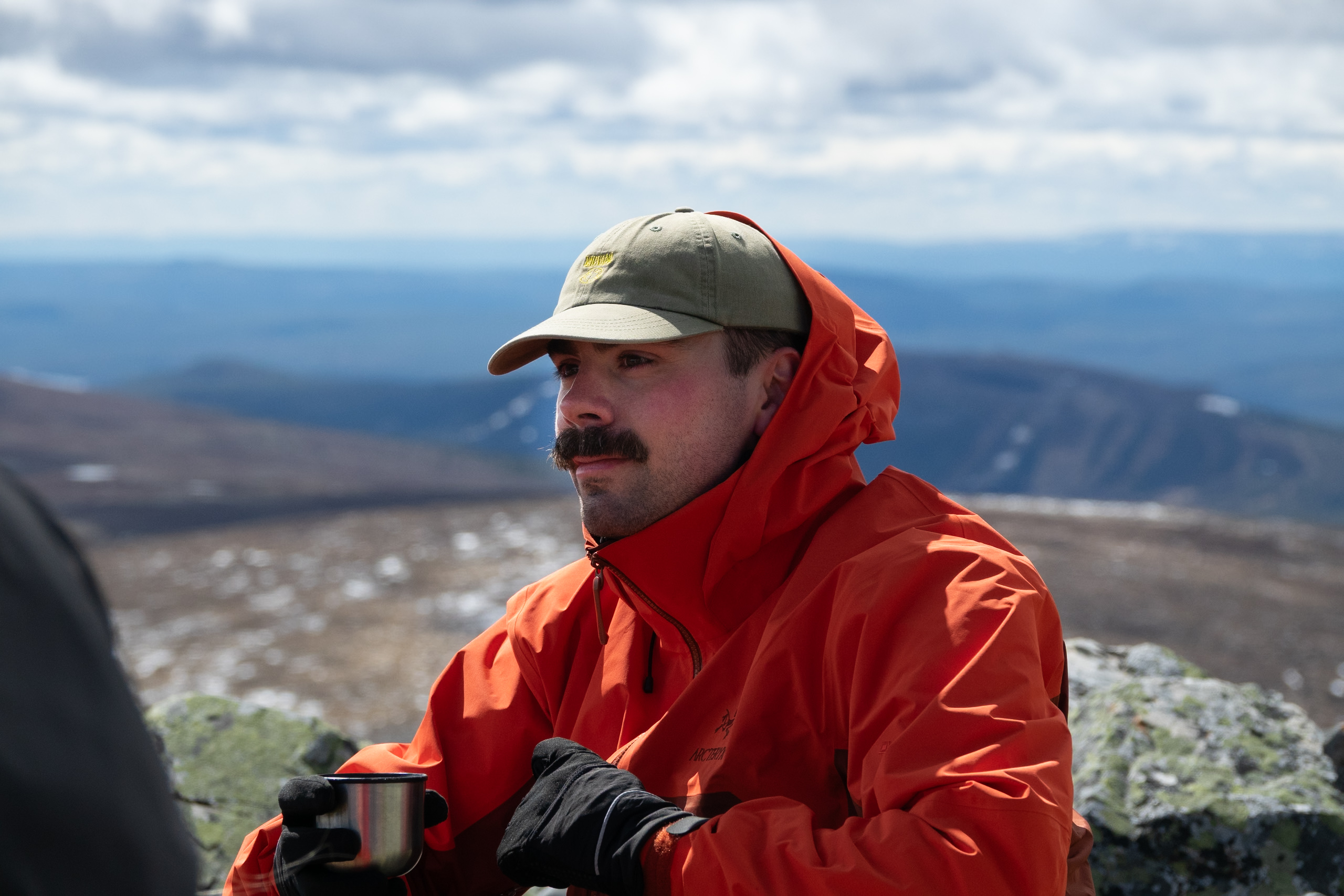
Luke Urso
I recently completed a master’s in Polar Landscapes and Quaternary Climate at Stockholm University, where my research was about how meltwater behaves on the Greenland Ice Sheet. My thesis mapped twelve years of slush and supraglacial lakes on the Petermann and C.H. Ostenfeld glaciers in northern Greenland, and used that record to study how surface water moves, pools, and suddenly drains across the ice.
Master’s thesis
Working in Google Earth Engine, I classified slush and ponded meltwater from Landsat 8 and 9 imagery with a Random Forest classifier adapted from Dell et al. (2022), and estimated lake volumes following Pope et al. (2016) and Moussavi et al. (2020). To get past the usual limits of optical monitoring, I built custom slope- and cloud-shadow masks that let me track surface water at roughly two-day intervals, fine enough to catch rapid lake drainage events as they happen. The result was a high-frequency, long-term record of meltwater area, elevation, volume, and drainage for both glaciers. The work was supervised by Dr. Nina Kirchner and Dr. Abhay Prakash.
You can read the full thesis here: Twelve Years of Slush and Supraglacial Lakes on Petermann and C.H. Ostenfeld Glaciers from Supervised Classification (PDF).
The code behind the thesis is open on GitHub at MSc_ThesisScripts. It collects the Earth Engine and Python workflows used in the analysis, along with a public drainage-event viewer that shows before-and-after Landsat composites of individual drainage events (running it requires an Earth Engine account).
Background
Before Stockholm I completed a post-baccalaureate in Geographic Information Systems at Pennsylvania State University and a B.A. & Sc. in Global Change Ecology and Integrated Resource Management at Quest University in Canada, where I focused on coastal responses to sea-level rise and joined the 2020 Quest University Antarctic Field Expedition. Earlier research took me from sea-level-rise adaptation policy across 130 coastal countries (with the UBC Institute for the Oceans and Fisheries and ELAW) to marine invertebrate biodiversity surveys at the UC Davis Bodega Marine Laboratory. Day to day I work with Google Earth Engine, the Esri suite, QGIS, R, Python, and JavaScript.
Get in touch
Feel free to reach me at lukeurso@me.com.